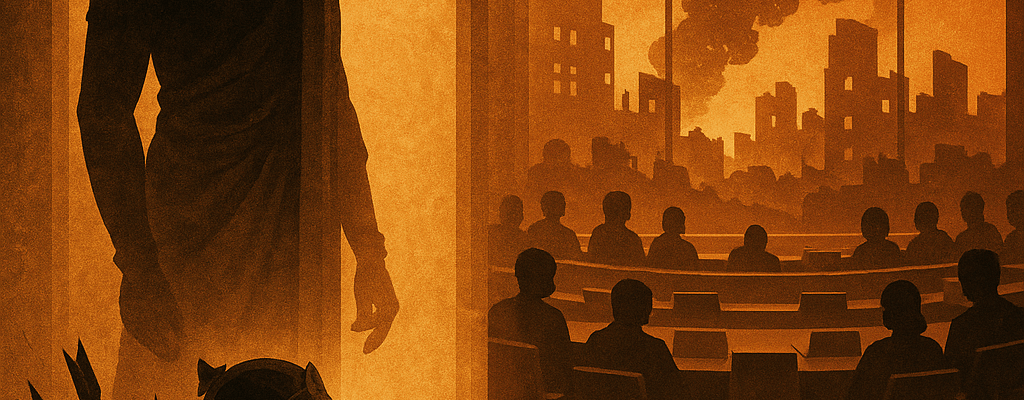

There are moments in history—both mythic and modern—that serve as mirrors, forcing us to confront the enduring nature of power, morality, and complicity.
In the epic corridors of Mahabharata, one such moment unfolds with harrowing stillness: Draupadi, the empress of Indraprastha, is dragged into the court of Hastinapura, humiliated before kings and kin. Her cries pierce through dharma (duty, righteousness, or law) itself. And yet, not a hand is raised. Among the gathered is Bhishma Pitamah—the grand patriarch of the Kuru dynasty, the one whose very name evokes strength, wisdom, and discipline.
And yet… he remains silent.
Bound by his vow to serve the throne—regardless of who occupies it—he stands still as adharma takes center stage. His silence is deafening. His inaction is damning.
This scene is not a relic of ancient scripture—it is a metaphor for every age.
Today, in the scarred landscape of Gaza, a modern courtroom of injustice is laid bare. Children die before they learn to walk. Families disappear under rubble. Hospitals, schools, and shelters—supposed sanctuaries—become the first targets. The blood of the innocent cries out, not to mythical deities, but to a global community that prides itself on human rights and justice.
And what do we see?
A familiar paralysis.
The leaders of powerful nations, the self-proclaimed defenders of global morality, sit in modern-day sabhas—parliaments, councils, and conferences. They issue statements of concern, weigh their words with bureaucratic precision, and then… do nothing. Just like Bhishma, they are not powerless. On the contrary, their very presence could shift the tides of history. But caught in the web of political alliances, economic deals, and strategic calculations—they choose silence. They cloak inaction as neutrality and indifference as diplomacy.
The parallel could not be more stark.

Just as Bhishma’s loyalty to the throne rendered him blind to its injustices, today’s geopolitical powers have allowed allegiance to policy to override allegiance to humanity. And just as the Kaurava court allowed one woman’s dignity to be shredded for the sake of unity, the world today is watching the dignity, the survival, and the soul of a people being shredded—for the sake of preserving the status quo.
But let us not be mistaken: silence is not neutrality. It is a position. It is complicity. When the powerful remain mute while injustice roars, they do not stand apart—they stand beside the oppressor.
A Dialogue in the Dusk of Conscience
As Bhishma lay on his bed of arrows—wounded not only in flesh but in spirit—Krishna visited him, not as the Supreme Personality of Godhead, but as the voice of Dharma.
Krishna: “Pitamah, you were the mightiest. Your breath could stir the wind; your will could shape kingdoms. Why did you not stop it?”
Bhishma: “I was bound by my vow… to the throne, to the order I swore to protect.”
Krishna: “And what of the higher vow? The one beyond kings and courts—the vow to righteousness itself? Does dharma serve thrones, or do thrones exist to uphold dharma?”
Bhishma: [Silent]
Krishna: “In that court, when a woman’s dignity was gambled away, your silence tipped the scales. You did not strike her—but your stillness gave her violators permission.”
Bhishma: “I see that now… But then, I feared the collapse of order if I opposed the throne.”
Krishna: “There can be no order without justice, Pitamah. What you preserved was not order—it was the illusion of it. And illusions are brittle.”
This conversation, though not recorded in scripture as such, reflects an inner war greater than Kurukshetra—the battle between allegiance and conscience. The war between what is lawful, and what is right.
In the aftermath of Draupadi’s humiliation, war became inevitable. Not because anyone desired it, but because dharma, once breached and left unacknowledged, demands a reckoning. Today, Gaza too may become a turning point—not just for the region, but for the world’s collective conscience. Every bomb dropped is not just a geopolitical act; it is a moral test—and far too many are failing it.
Bhishma’s own journey ended with a deathbed of arrows, where he finally spoke of righteousness, regret, and the price of inaction. He was revered not just for his might, but for the tragic wisdom that came too late. His story was a warning to generations: that power without moral courage is nothing but polished armor over a hollow chest.
How many Bhishmas stand in our world today? How many will one day look back and realize they were present at the unravelling of justice and did nothing?
To remain silent in the face of genocide is not diplomacy—it is betrayal. To turn away from suffering while holding the means to stop it is not wisdom—it is cowardice. And to dress it in the language of political complexity is to add insult to injury.
History is watching.
And history remembers—not just the tyrants, but those who watched them with folded arms.
May we have the courage, one day soon, to break this cycle. To rise not just with weapons or speeches, but with will—to protect the innocent, to honour our shared humanity, and to ensure that the silence of the strong is no longer mistaken for strength.
 Virdee's Blog