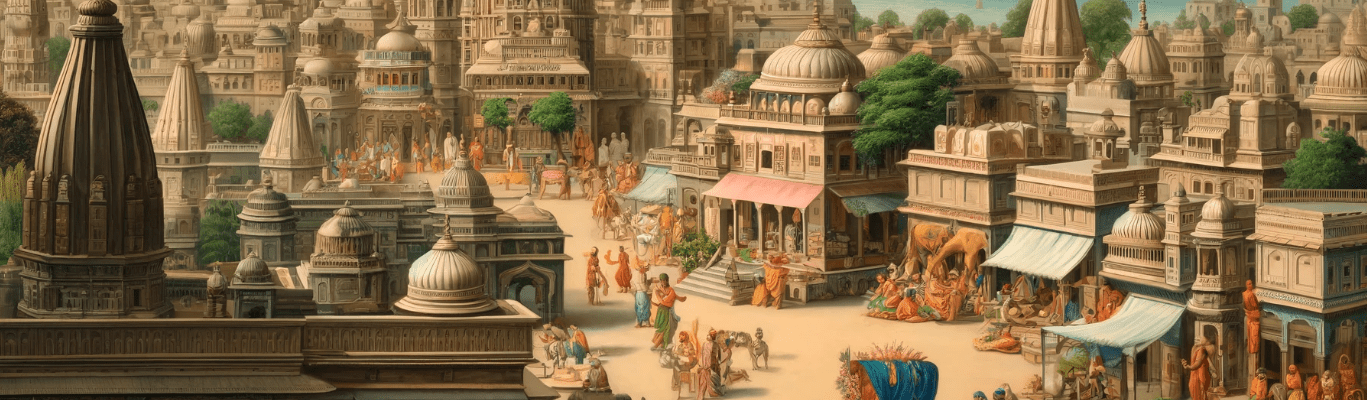

In the tapestry of spiritual literature, few themes resonate as profoundly as the enduring bonds of friendship interwoven with divine love. Bhagat Namdev Ji’s hymn, rendered in the sacred pages of the Sri Guru Granth Sahib, captures the quintessential spiritual narrative through the lens of the legendary friendship between Sudama and Lord Krishna. This relationship emulates the divine’s unconditional love and humility, transcending mere earthly ties to portray a celestial camaraderie that guides souls toward spiritual enlightenment.
This blog post seeks to explore the divine message embedded within Naamdev Ji’s verses, emphasizing how this historical friendship reflects the broader spiritual principles that are central to the Bhakti movement. Sudama, a figure of simplicity and devotion, and Krishna, a deity revered in the pantheon of Hindu gods, converge in a story of mutual respect and spiritual kinship. Through their interactions, we uncover the virtues of humility, the value of spirituality over material wealth, and the profound truth that divinity responds to the purity of devotion, not the grandeur of offerings.
Join me as we delve deeper into Bhagat Namdev Ji’s hymn, drawing parallels between this ancient friendship and the universal quest for divine connection, illustrating how spiritual bonds are not just formed between mortals but can also bridge the human with the divine. This narrative invites each of us to reflect on our spiritual journeys and the relationships that guide us closer to the divine essence.

Namdev, a prominent poet-saint of the Bhakti movement, renowned for his devotion to Lord Vishnu. He was born around 1270 AD in the village of Narsi Bamani, in the Hingoli district of Maharashtra, India. Namdev Ji was part of the Varkari sect, which emphasizes the worship of Lord Vithoba, a form of Krishna. Naamdev Ji travelled extensively across India, visiting holy places and engaging with other saints. His hymns, or shabads, which focus on devotion to a single God and criticize caste discrimination, found a profound resonance with the teachings of Sikhism. As such, 61 of his compositions are included in the Guru Granth Sahib, the holy scripture of the Sikhs. Namdev passed away in 1350, but his legacy continues to be celebrated, especially in Maharashtra and by Sikhs worldwide. His life and works emphasize the unity of God and the importance of living a life of simple faith and devotion, devoid of ritualistic complexities.
ਹਲੇ ਯਾਰਾਂ ਹਲੇ ਯਾਰਾਂ ਖੁਸਿਖਬਰੀ ॥
hale yaaraa(n) hale yaaraa(n) khusikhabaree ||
Hello, my friend, hello my friend. Is there any good news?
The hymn, like many others in the Guru Granth Sahib, encourages devotion not just through external forms but through the understanding and internalization of divine qualities and messages. Bhagat Naamdev Ji uses the imagery of Dwarka not just as a literal place but as a symbolic reference to explore deeper philosophical and spiritual questions about the nature of sacredness and the source of divine influence.
Bhagat Namdev Ji’s hymn captures themes that resonate strongly with the story of Sudama’s friendship with Lord Krishna—principally, the ideas of humility, divine love, and the transformative power of pure devotion. Sudama, a humble and poor friend of Krishna, is remembered for his visit to Krishna’s palace where he brought nothing but a handful of beaten rice as a gift. Krishna’s reception of Sudama, treating him with utmost love and respect, highlights the divine qualities of humility and the recognition of true devotion over material offerings.
In context with Sudama and Krishna, these questions can symbolically align with Sudama’s own spiritual and life journey as he reunites with Krishna. Their dialogue isn’t just a catch-up between friends; it is layered with spiritual depth:
- Origins and Journey (Where did [you] come from? Where did [you] go?): Sudama comes from a place of poverty but rich in devotion and humility. His journey to Krishna is not just a physical journey from his home to Dwarka but a spiritual passage from a state of worldly suffering to divine communion.
- Current State (Where are [you] staying?): This can be interpreted as questioning where Sudama finds himself in life at the moment of his meeting with Krishna, both in a literal and a spiritual sense. It emphasizes the spiritual state or the presence in the divine proximity where real “staying” or existence is realized.
- Spiritual Realization: In Krishna’s welcome and treatment of Sudama, the physical and material statuses are transcended, highlighting the spiritual equality and the eternal bond shared between them. This reflects the essence of the hymn’s question, pointing towards an understanding that our true state and value are not determined by worldly measures but by our spiritual connections and inner purity.
Namdev Ji’s poetic inquiry serves as a spiritual examination, inviting us to consider our origins not in a literal sense, but as a metaphor for our initial state of innocence and purity. It prompts us to think about our life’s trajectory in terms of spiritual progression towards, or perhaps away from, that original state of connection with the divine. This is mirrored in the story of Sudama, whose humble origins and pure devotion lead him to the divine grace of Krishna, reminding us that spiritual wealth transcends all material lacks.
As we navigate through the narrative of the hymn, we encounter various aspects of divine qualities—sweetness in speech, grandeur in presence, and questions about the sanctity of sacred spaces like Dwarka. These are not just attributes but are symbolic of the deeper virtues one should aspire to embody. The query, “Where are you staying?” transcends physical location, asking instead about the state of one’s heart and soul. Are we residing in a place of spiritual growth, or are we lost in material illusions?
In a broader sense, Namdev Ji’s verses in the Guru Granth Sahib encourage a personal internalization of divine lessons, urging us to seek a deeper, more personal connection with the divine essence. This connection is portrayed as the ultimate journey, from the origin of our purest self to our spiritual evolution and final destiny in divine embrace. The hymn thus becomes a reflective mirror, prompting each of us to assess our spiritual bearings: to consider where we have come from spiritually, where we are currently in our spiritual walk, and where we are headed in our quest for divine union.
ਕੁਜਾ ਆਮਦ ਕੁਜਾ ਰਫਤੀ ਕੁਜਾ ਮੇ ਰਵੀ ॥
kujaa aamadh kujaa rafatee kujaa me ravee ||
Where did you come from? Where have You been? And where are You going?”
Where did you come from, where are you going?” encapsulates this entire spiritual expedition. It challenges us to remember our divine origin, recognize our present state, and reorient ourselves toward a spiritual destination characterized by deeper understanding, humility, and devotion. As we ponder these questions, let us embrace the journey with the same fervour and sincerity that Sudama showed, knowing that the path we tread is watched over by the divine, just as Krishna watched over Sudama, offering us not just answers, but way back to our spiritual home.
This beautiful hymn is located on Ang (page) 727 of Sri Guru Granth Sahib Ji composed in Raag Tilang. (https://www.sikhitothemax.org/shabad?id=2782)


Loved your description. Check out mine….
LikeLiked by 1 person